
Kea Insight / Analyst Relations
Analyst Relations Has Moved Upstream
Analyst Relations is often judged by its visible work: briefings, research participation, evaluation support and the urgent request from sales when a deal gets stuck. That work still matters, but it does not describe the whole function. AR also helps a company understand how external experts see its market, where buyer expectations are changing and whether its positioning stands up to scrutiny.
This is the shift upstream. The value of an analyst relationship lies partly in what the company learns before the next briefing, product decision or sales conversation. When that learning reaches the right people, AR becomes a source of market intelligence with commercial consequences.
Why AR emerged
AR emerged from the complexity of enterprise technology buying. Buyers were making expensive decisions that could shape their infrastructure and operations for years. They needed an outside perspective on vendors, technical choices and market direction. Analyst firms built their influence by helping those buyers compare options and reduce uncertainty.
IBM provides a useful starting point for understanding that environment, rather than a claim that one company invented the discipline. Large technology vendors operated across complex markets, with long sales cycles and advisers who could influence buyer confidence. Vendors needed a structured way to explain their businesses, provide executive access and address misunderstandings in the market.
The early AR remit reflected those needs: understand the analysts, brief them properly, explain the roadmap and support their research. Those responsibilities remain. What has changed is the range of information available to buyers and the number of people inside a company who can use the intelligence those relationships produce.
From information scarcity to signal scarcity
Analysts have long been valuable because they can see across vendors and buyers in ways that an individual company cannot. The internet expanded access to information through vendor content, peer reviews, independent consultants, communities and specialist publications. AI adds another means of finding and interpreting that material. The difficult question is increasingly which information deserves confidence, rather than whether information exists.
For AR, this raises the standard of preparation. A product tour is useful only when it answers the analyst’s questions. What has changed? Which customers demonstrate the value? How does the offering fit the category, and where does it differ? Evidence, context and a willingness to discuss limitations matter more than the volume of material supplied.
Listening is therefore part of the work, not a preliminary courtesy. The analyst’s questions can expose gaps in customer proof, unclear positioning or assumptions that the company has stopped questioning. A briefing calendar records activity; it does not tell the business whether it has learned anything.
What AR is
Analyst Relations is the structured practice of engaging industry analysts and advisory firms so a company can learn from the market and help the market understand the company. The relationship works in both directions. A useful programme asks how analysts define the category, which buyer problems are gaining importance and where the company’s claims need stronger evidence.
That intelligence should reach product marketing, product strategy, sales enablement, customer teams and leadership. It can help test positioning, identify reference gaps and prepare executives for questions they will also face elsewhere. Briefings, research participation, evaluation support and licensed research assets then draw on a better-informed account of the business.
The distinction is practical. When AR only distributes an agreed message, its contribution is limited to communication. When it also brings external challenge into the company, it can improve the message and the decisions behind it. The business still owns those decisions; AR provides an informed outside perspective.
What AR is not
AR is not PR with a different contact list. The two functions can reinforce each other, but their working relationships differ. Journalists typically work through stories, deadlines and editorial priorities. Analysts work through research agendas, advisory conversations, evaluation criteria and continuing assessments of market direction. Good media coverage does not replace sustained analyst engagement.
Nor is AR a shortcut to a favourable evaluation. Gartner Magic Quadrants, Forrester Waves, IDC MarketScapes and specialist assessments have their own scope and criteria. A programme can improve preparation and the quality of evidence submitted; it cannot promise inclusion, a position or an endorsement. Market relevance, product substance and customer outcomes must support the argument.
Analyst independence is central to this relationship. AR should make the company easier to assess, not ask an analyst to accept an unsupported claim. The objective is accurate understanding and useful challenge, including when the feedback is uncomfortable. Agreement is not the only worthwhile outcome of a conversation.
The commercial connection
The commercial relevance becomes clear when an analyst’s view enters a buying decision. Analysts can influence how buyers frame requirements, assess risk and compare a shortlist. They do not sell on the vendor’s behalf, but their advice can affect buyer confidence. Sales teams need to understand that context before an objection becomes a late-stage surprise.
AR can help sales interpret relevant research, prepare for analyst-informed questions and use third-party material within its licensing and quotation rules. Customer teams contribute the evidence behind the claims. Product marketing turns that evidence into language buyers recognise. These are connected responsibilities, not a request to put a report graphic into every presentation.
Measurement should reflect that connection. Briefing counts and report mentions describe activity and visibility. Changes in analyst understanding, stronger references, useful feedback adopted by the business and support for specific opportunities provide a fuller account of contribution. Revenue claims need care: AR operates alongside product, sales, marketing and the customer’s own decision process.
Working with product marketing
AR belongs in close working contact with product marketing because both functions need to understand how buyers see the company. Product marketing brings positioning, competitive knowledge and customer context. AR brings an external view that can test whether the category language, differentiation and evidence are convincing beyond the organisation.
An analyst may question a distinction the company considers obvious, identify a competitor it has underestimated or ask for outcomes its references do not yet demonstrate. The useful response is to investigate, not simply rewrite the next briefing deck. Some feedback will justify a change; some will not. The company needs a way to make that judgement and explain the decision.
This does not prescribe one reporting line for every business. AR can sit in different organisational structures and still do the job well. What matters is access to the people who can act on the intelligence, clear responsibility for follow-through and sufficient independence to bring challenging feedback into the discussion.
What could change by 2030
Looking towards 2030, our expectation is that AI-assisted research will increase the importance of credible, accessible evidence. This is a direction of travel, not a guaranteed forecast. As buyers delegate more comparison and initial research to AI tools, companies will need to understand how those tools describe their category, capabilities and limitations.
That does not mean every AI answer draws on analyst research, or that an analyst relationship secures visibility in an AI-generated shortlist. Source access, licensing, retrieval and model behaviour differ. AR’s contribution is to help the company understand influential outside perspectives and maintain accurate evidence, working with content, search and product marketing teams where their responsibilities meet.
AI can also change the work inside an AR programme. It can assist with briefing preparation, organising authorised notes, comparing feedback and identifying recurring questions. People still need to check the source, protect confidential material and distinguish a repeated observation from a model-generated inference. A polished summary is not a substitute for understanding what an analyst actually said.
The more useful operating model is likely to be continuous rather than organised around a handful of annual milestones. Feedback needs to reach its owner while it is relevant. Customer evidence needs to stay current, and changes in market perception need to be checked against more than one source. Faster processing can support that work; it cannot replace judgement, trust or accountability.
The AR operating model
AR connects market feedback with decisions inside the business. It gathers and tests external observations, brings relevant findings to the people who can act on them, and uses the resulting decisions and evidence to inform subsequent analyst conversations. Over time, that process should improve both the company’s understanding of the market and the market’s understanding of the company.
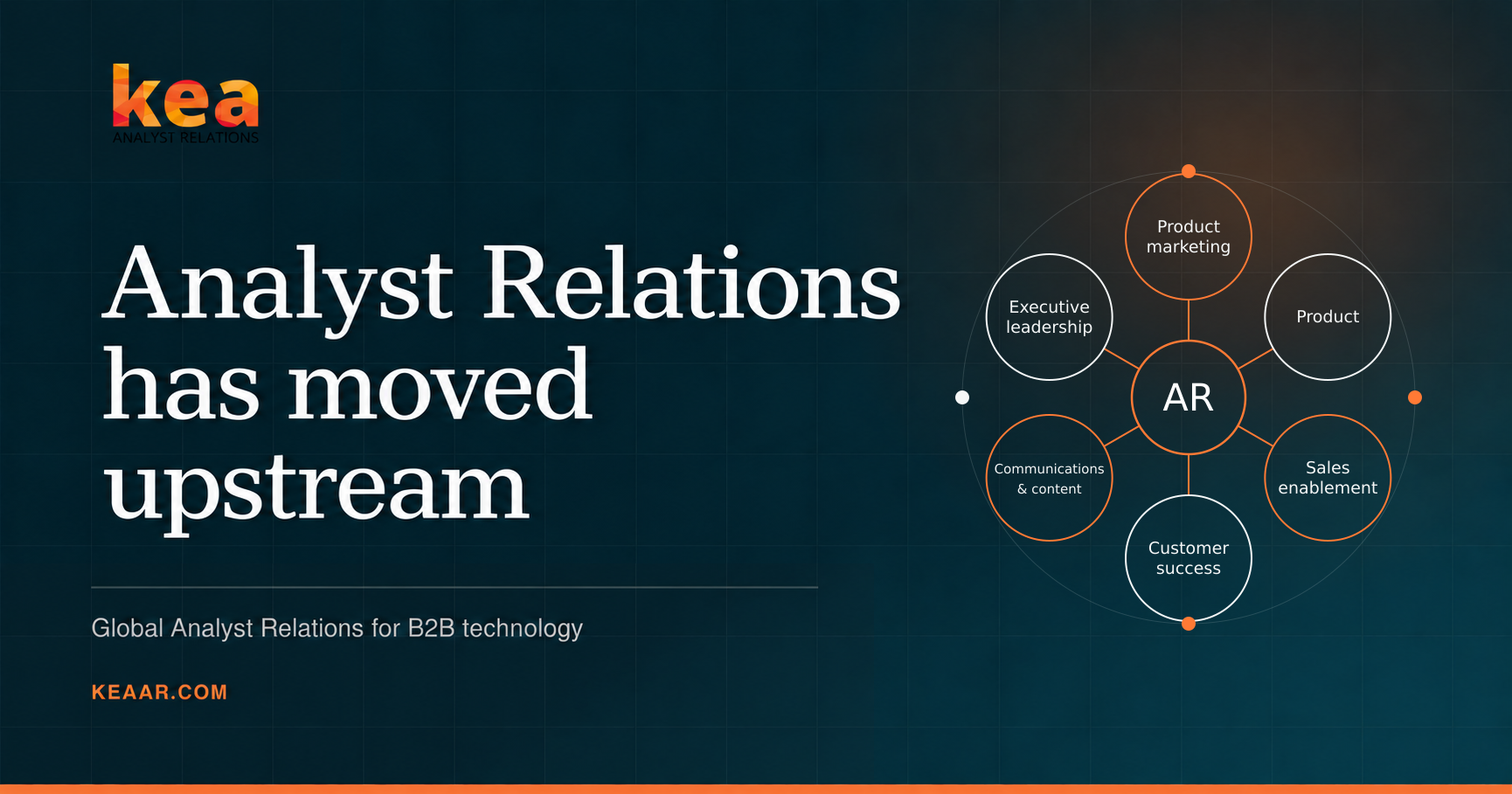
Product marketing uses the feedback to test positioning and category language. Product teams consider it alongside customer research and their own priorities. Sales enablement turns relevant findings into usable guidance, while customer success helps identify outcomes and references that substantiate the claims. Communications and content maintain consistency in the public story, and leadership resolves strategic questions that cross departmental boundaries.
AR coordinates these connections without owning every decision. A useful review records the observation, its source, the business implication and who will follow it through. The next conversation then checks what changed. That is how a relationship programme becomes an operating discipline rather than a sequence of meetings.
What this means for the business
Analyst Relations has moved upstream without leaving its original responsibilities behind. Briefings, evaluations and relationships still matter. Their value increases when the intelligence they generate helps the business improve its positioning, evidence and decisions before it returns to the market.
The question for leadership is therefore broader than which analysts to brief next. It is what those analysts are seeing that the company needs to understand, and whether anyone is responsible for acting on it. That remains a useful test as AI changes how information is produced and consumed: does the AR programme help the business learn, decide and explain itself more credibly?
Put this into practice
Give your market story stronger evidence.
Bring leadership, product and marketing together to test the story, identify proof gaps and prepare for informed analyst questions.
Explore AR WorkshopsNot sure where to start? Take the eight-question AR Readiness Check.