01
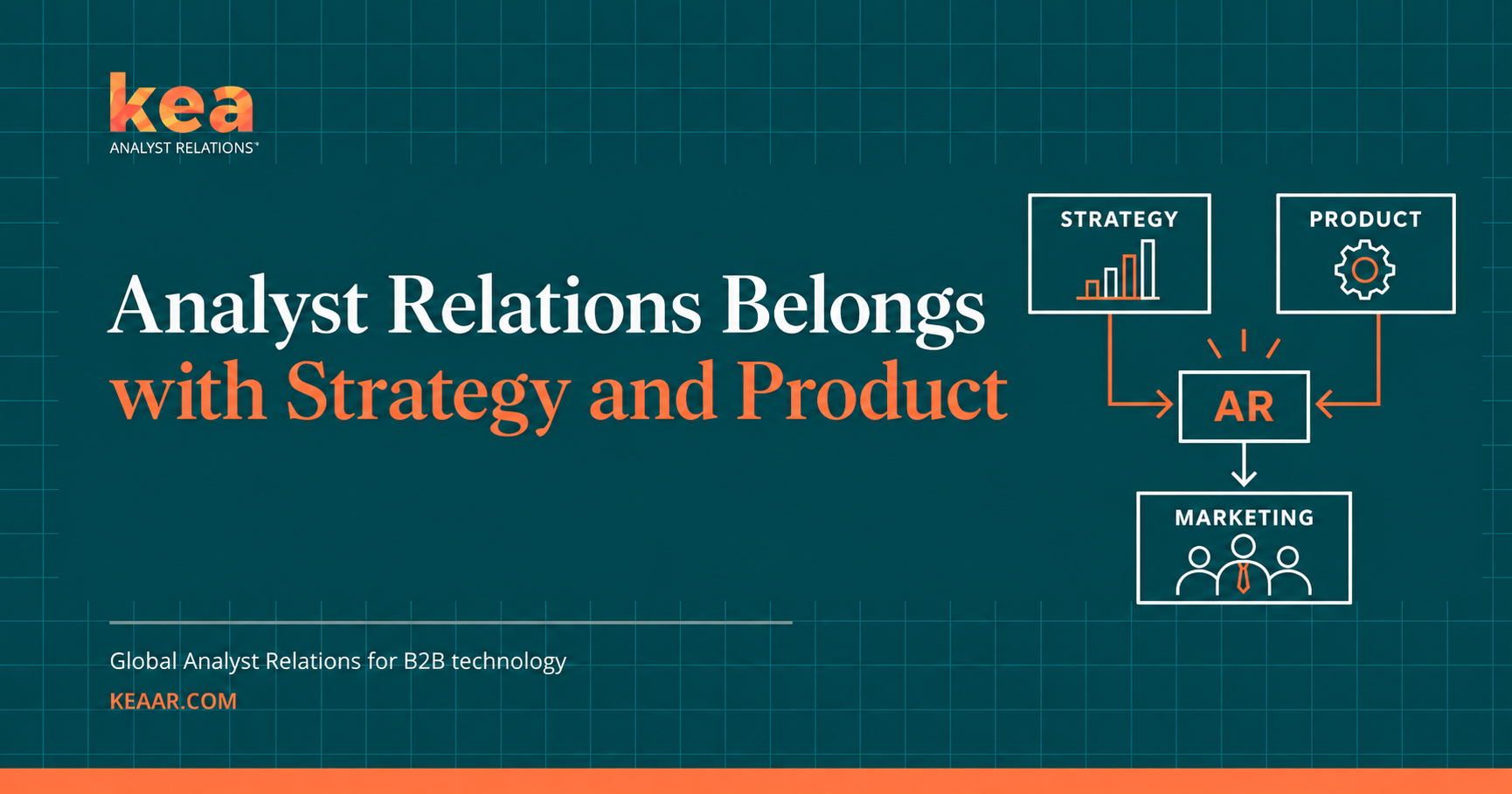
Analyst Relations Belongs with Strategy and Product
Put Analyst Relations with Strategy or Product. Give the programme clear decision owners, access to evidence and funding tied to business needs.
A Kea publication / The newsletter
The analyst market. Without the noise.
Sharp perspectives on research firms, market influence and the decisions facing B2B technology leaders.
A research subscription gives you access. The decisions remain yours.
Put Analyst Relations with Strategy or Product. Give the programme clear decision owners, access to evidence and funding tied to business needs.
Executives do not need a diary of analyst activity. They need to know what changed, what it means for the business, where support is required and whether the programme is moving its intended outcomes.
An analyst summit can create depth and efficiency when several analysts genuinely need the same strategic context. It can also become an expensive presentation marathon. Know which problem you are solving.
Analysts can influence a buying process long before a vendor sees an RFP by shaping the buyer’s language, categories, requirements, shortlist and sense of risk.
Analyst research is not created from vendor briefings alone. It combines market evidence, client conversations, vendor input, surveys, product knowledge and the analyst’s own judgement.
AR maturity is not a count of briefings. It is the degree to which the programme has clear objectives, ownership, repeatable processes, useful relationships and measurable business outcomes.
There is no universal AR team size. The right answer depends on the number of markets, analysts, executives and business decisions the programme has to support.
A briefing gives the analyst information. Paid advisory work gives your company access to the analyst's expertise. Know which problem you are solving before you buy the time.
Analyst research can strengthen sales and marketing, but only when the company uses licensed material accurately, preserves context and avoids turning independent analysis into a claim of endorsement.
Paying an analyst firm for a webinar buys expertise, format and audience access — not endorsement. The value depends on the objective, the analyst, the audience and what you can reuse afterwards.
A useful analyst briefing deck frames the market, explains where you fit, shows customer proof and leaves room for discussion. It is not an investor pitch or a product catalogue.
Firm size and brand recognition are poor substitutes for relevance. A practical framework for deciding which analyst firms deserve your time, executive access and budget.
Executive participation is not executive sponsorship. A serious Analyst Relations programme needs an owner who aligns priorities, unlocks resources, resolves conflicts and reviews whether the programme is changing market understanding.
A practical guide to analyst perception audits: test what relevant analysts understand, separate fact from inference and track whether market understanding is actually moving.
When your AR lead is away, protect the analyst commitments that matter. A practical handover and cover plan for an existing team.
Gartner, Forrester and IDC are major analyst firms with different research, advisory and evaluation models. Vendors should prioritise the analysts and mechanisms that matter to their market instead of treating the three logos as interchangeable.
Enterprise buyers build trust before sales by combining analyst views, customer proof, peer reviews, consultant input, search results, AI summaries and internal conversations.
A briefing primarily helps the analyst understand the vendor. An inquiry or advisory session primarily helps the company understand the analyst's perspective. Strong AR programmes use both intentionally.
A strong analyst briefing is won before the meeting starts: understand the analyst, define one objective, build the market story, map claims to evidence and prepare the people in the room.
Analyst engagement works when targeting, analyst relevance, evidence, interaction type, follow-up and internal action operate as one system—not as a calendar of disconnected meetings.
An Analyst Relations agency can provide strategy, analyst mapping, engagement, briefing preparation, evaluation support, research monitoring and measurement—but the useful distinction is whether it improves market understanding, not how many meetings it books.
Everest Group is more than its PEAK Matrix. Learn what the firm covers, how assessments work and when technology and services providers should engage.
Analyst Relations and Public Relations overlap, but they serve different audiences, operate through different interaction models and create different kinds of market understanding.
Analyst Relations is the discipline of building informed, evidence-based relationships with the industry analysts who shape how technology markets, vendors and buyer choices are understood.
Your analyst list should reflect the market you are trying to influence now—not the relationships you inherited. A practical guide to deciding who really deserves your time.
Your roadmap is a statement of intent, not proof the market will follow. How product teams can use analyst insight to test assumptions before they become expensive commitments.
A practical guide to competitive intelligence: understand why buyers choose an alternative, test competitive claims and turn analyst insight into decisions for sales, product and leadership.
Research and insight are stepping stones towards your business goals. A practical guide to choosing, using and renewing analyst subscriptions—and doing the work that turns knowledge into progress.
Use customer review themes to sharpen briefing evidence, test positioning and identify questions worth discussing with analysts.
Why repeatedly asking the same customers for references puts buyer trust, analyst evidence and valuable relationships at risk—and how to build a stronger evidence programme.
Build useful analyst updates between launches around customer learning, deployment evidence and changes in the questions buyers ask.
A practical way to review recurring AR work, protect important commitments and free capacity for the decisions that matter.
ISG Provider Lens is more than a provider quadrant. Learn how its sourcing-advisory context, regional research and evaluation process matter to vendors.
Analyst Relations is no longer only about briefing analysts or supporting evaluations. It has become an upstream market intelligence function with direct impact on positioning, product, sales and market perception.
Research inclusion can shape a buyer's shortlist before a reprint is licensed. Here's how to distinguish research visibility, paid campaigns and analyst advice.
Manage an analyst departure with clear ownership, current coverage information and a handover plan for interim and permanent replacements.
Respond to analyst-related deal concerns with a clear intake process, verified evidence and a practical next step for the account team.
Build an AR scorecard that separates activity, understanding and commercial contribution, with evidence leadership can use to make decisions.
Build an evaluation evidence register with verified claims, clear owners and current proof before the analyst questionnaire arrives.
Prepare an analyst product demo around a clear question, a focused workflow and the evidence behind the claim. Build the session with Kea.
Turn a briefing into clear actions, named owners and useful follow-up. A practical approach to keeping analyst engagement moving.
Move beyond customer logos. Give analysts the deployment detail, business outcomes and context they need to assess your customer evidence.
Turn analyst research into a concise sales card that helps account teams answer buyer questions with relevant evidence and clear next steps.
Ask buyers where analyst advice influenced their decision. A practical way to build evidence of AR’s contribution through win–loss conversations.
Nucleus Research looks beyond features to usability, functionality and ROI. Learn how its Technology Value Matrix and deployment evidence matter to vendors.
A strong product can be excluded before sales sees the opportunity. How Analyst Relations helps buyers and analysts understand where a vendor fits and why it deserves consideration.
Do sourcing advisers influence your buyers? Map the relevant relationships, address evidence gaps and give the work a clear owner with Kea.
AI search is changing how enterprise buyers discover vendors. Bram Weerts explains why Analyst Relations, third-party proof and clear market language now decide whether AI systems understand you correctly.
Research processes are changing. Bram Weerts explains why analyst influence still matters when enterprise technology buyers need confidence and context.
Technology start-ups do not need to wait for perfect. Start Analyst Relations when the market needs to understand you and the company has enough story, evidence and leadership commitment to engage credibly.
For companies selling €500,000 enterprise deals, Analyst Relations is not an abstract marketing expense. It is a practical way to reduce revenue risk before an opportunity reaches sales.
Positioning is what a company wants the market to believe. Buyers act on the picture created when those claims meet customer evidence, independent opinion, analyst understanding and lived experience.
Analyst Relations benchmarking should measure more than activity. Kea explains how 20,000+ analyst interactions help assess briefing quality, patterns and progress.
Keep industry analysts accurately informed when plans change. Kea coordinates the update, product evidence and follow-up around your revised commitment.
Why a focused analyst relations programme helps the right people understand your company before buyers ask them for advice.
AI can turn market reputation into a buyer’s first impression. Bram Weerts explains what CMOs should test, substantiate and keep current.
Relationship history, relevance and timing matter more than contact counts. How commercial leaders turn an existing network into useful conversations.
A sharper deck cannot fix an unclear market position. How B2B leaders connect their product story to the change buyers actually care about.
Buyers will simplify your company. Make sure the version they remember reflects your current capabilities, customers and market relevance.
A practical guide for sales and marketing: identify the research, reviews and AI answers shaping a buyer’s shortlist, then act on the evidence.
Build an analyst relations budget around services your team can use. Bring the proposal to Kea and establish the requirement before you commit.
Derk Erbé explains how executives can prepare clearer analyst conversations, support their narrative with evidence and build lasting market understanding.
In-house Analyst Relations can work very well. The risk is improvisation: weak targeting, poor preparation and learning avoidable lessons on high-value analyst relationships.
Early product success does not guarantee expansion. Sven Litke looks at the gaps between product, marketing and sales that AR can help expose.
Analyst Relations readiness is not about company size. Test the market story, evidence, competitive honesty, leadership openness and ability to act on feedback.
Analyst firms now combine research, advisory, peer data, events and commercial services. AR teams need to understand which relationship they are actually in.
Founders know the company from the inside. Analysts provide an external test of positioning, market fit, evidence and assumptions before internal conviction becomes market strategy.
Build analyst relations into your product launch. Plan the relevant conversations, prepare the evidence and keep follow-up connected with Kea.
What do the four quadrants actually mean, and what can a vendor’s position tell you? A straightforward introduction to the Gartner Magic Quadrant and how to read it in the context of your business.
A Forrester Wave compares selected providers in a defined market. Understanding its criteria, scores and customer feedback helps you see what the findings mean—and which questions still need answering.
An IDC MarketScape assesses vendors in a specific technology or services market. Here is how to understand its capabilities and strategies framework, read the findings and judge their relevance to your business.
Peer reviews are no longer only a customer marketing asset. They now shape buyer trust, analyst understanding, sales conversations and the evidence AI tools can find.
Is your leadership ready for critical analyst feedback? A practical guide to weighing evidence, benchmarking competitors and turning uncomfortable insight into decisions.
Practical guidance
Next step
Kea helps B2B technology companies build the relationships, evidence and market understanding required to change how they are seen.
Discuss Analyst Relations with Kea