
Kea Insight / Analyst Relations
Beyond Gut Feeling: Benchmarking 20,000+ Analyst Interactions
A briefing can feel successful without changing an analyst’s understanding of your company. Polite feedback, a lively discussion and a full calendar are useful signals, but they do not tell you whether the programme is improving. Benchmarking adds the missing context: how does this conversation compare with relevant experience elsewhere?
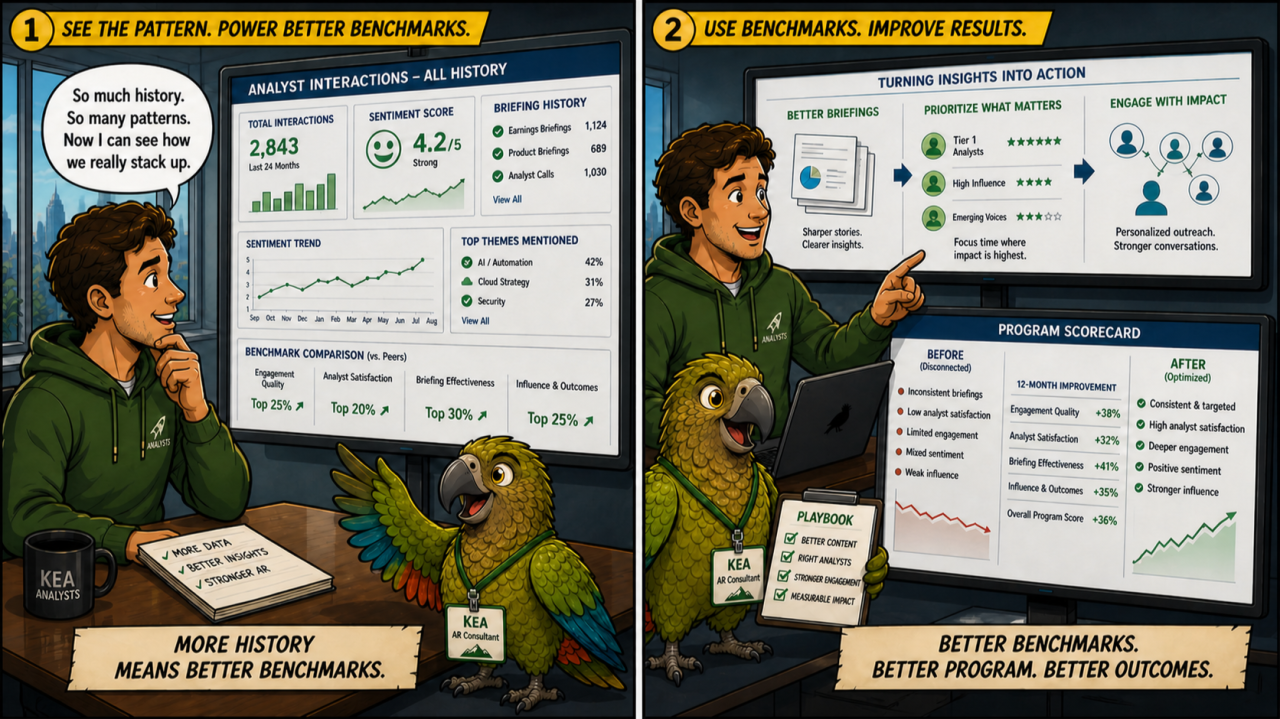
Kea has completed more than 20,000 analyst interactions across clients, technology markets and regions. That experience provides a broader reference point for assessing engagement than any one conversation or one company’s recent activity. Its value lies in asking better questions about performance and using the answers to improve the next interaction.
Start with the substance of the conversation
Activity reporting tells an AR team what happened: which analysts attended, what was covered and whether follow-up was requested. Assessing quality goes further. Did the analyst understand the use case? Were important claims supported? Did the discussion expose a misunderstanding or establish a useful next step?
A consistent scoring approach makes those observations easier to compare. The score should remain connected to the evidence behind it. An enthusiastic response without a clear change in understanding is different from a challenging discussion that identifies exactly what the vendor needs to prove.
Compare like with like
The first comparison is within the programme. Look across interactions over time, then examine the differences between topics, spokespersons or analyst groups. A lower score may reflect weak preparation, but it may also reflect a difficult objective or an analyst encountering the company for the first time.
- Internal patterns: identify where the story is understood consistently and where the same questions keep returning.
- Relevant external context: compare observations with similar engagements across Kea’s wider experience, taking the market, objective and relationship stage into account.
- Changes that merit investigation: examine a sustained decline or an unexpected improvement before deciding what caused it.
A broad reference set is useful because it reduces dependence on one team’s impressions. It does not make every interaction directly comparable. A first introduction and an established relationship update should not be judged as though they were the same assignment.
Turn the finding into a decision
Consider a programme in which analysts repeatedly ask who the product is for. Scheduling more briefings will not resolve that issue on its own. The team may need to sharpen its target customer definition, show a more relevant implementation example or explain how its category differs from adjacent markets.
The next interaction then provides a practical test: did the revised explanation resolve the confusion? This connects measurement with action. A dashboard that records scores without changing preparation, evidence or engagement priorities adds reporting work without improving the programme.
Keep the claims proportionate to the evidence
The number of completed interactions describes Kea’s operating experience. It should not be read as a claim that every interaction belongs to one uniform statistical study. Likewise, a higher engagement score is not proof of higher revenue. Commercial impact requires separate evidence from buyers, sales teams and the opportunities involved.
Used carefully, benchmarking helps an AR team distinguish a pleasant meeting from meaningful progress. It makes the reasons for improvement more visible and gives the team a stronger basis for deciding what to do next.
Read Kea’s perspective on analyst relations ROI, or explore how AR as a Service brings preparation, engagement and measurement into one programme.
Put this into practice
Give analyst engagement an owner and a next step.
Build preparation, follow-through and measurement into a sustained programme around your business priorities.
Explore AR-as-a-ServiceNot sure where to start? Take the eight-question AR Readiness Check.